Remote experiments at GSECARS!

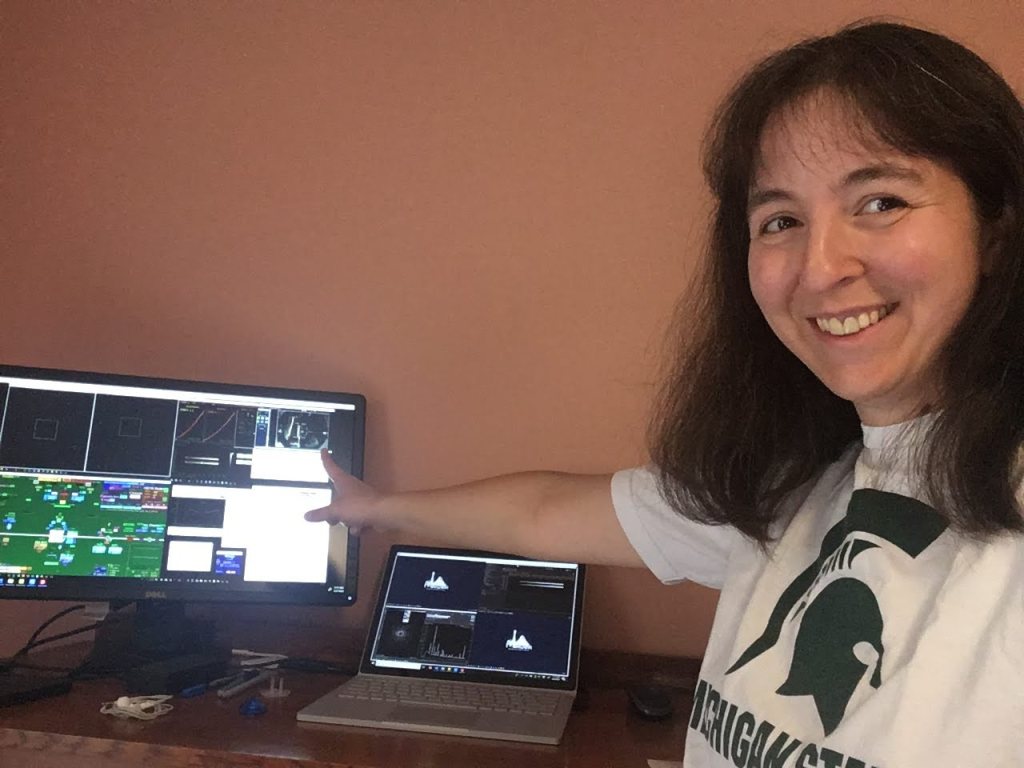
That’s our diamond anvil cell, right there!

We’re running our first remote experiments at Argonne today from our homes! Thanks to Mingda Lv, who prepared the DACs in our lab at MSU under approved quarantine safety procedures and mailed them to Argonne. Thanks to Stella Chariton, on-site beamline scientist handling all the physical tasks and coaching us through everything! And of course the rest of GSECARS, particularly Vitali Prakapenka, for getting remote operations working. Mingda can operate the equipment from his desk at his place, and I from my “standing desk” (bedroom bureau).

Awards 2019-2020

We’re overdue for another round of congratulations to group members on this past year’s achievements!

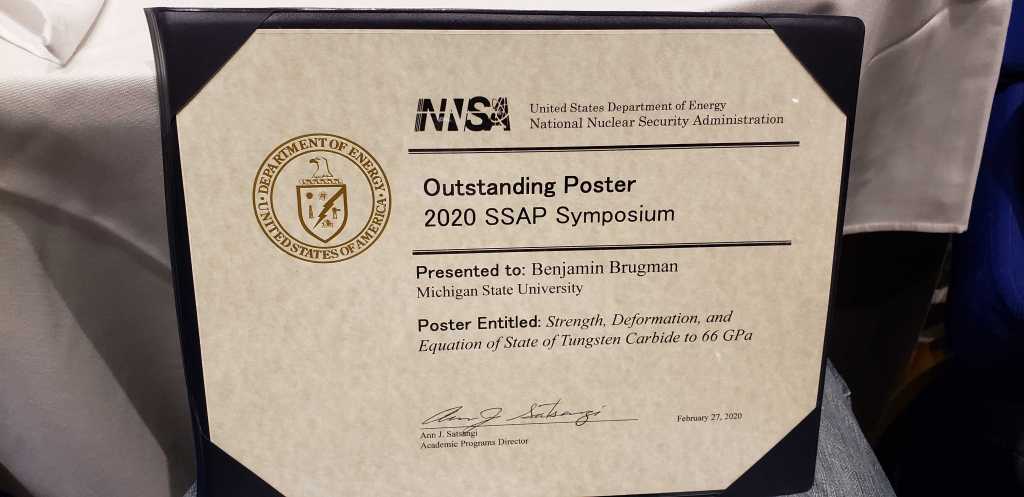
Congratulations to Benjamin Brugman on his 2020 Outstanding Poster Award at the NNSA SSAP Symposium!

Benjamin Brugman received a second presentation award for his work on the high-pressure deformation of tungsten carbide, this time at the National Nuclear Security Administration’s symposium for the Stockpile Stewardship Academic Programs (one of which is the Chicago-DOE Alliance Center, of which we are members).

Mingda Lv was awarded the Pringle Endowed Fellowship (for a second time) from the Earth and Environmental Sciences Department, in recognition of his academic and research excellence.

Mingda’s first first-authored paper from his work at MSU was also accepted in 2020! In addition, Suki’s paper on “Effects of composition and pressure on electronic states of iron in bridgmanite,” the result of work both at EPFL and MSU, is now in press at American Mineralogist.

Black Lives Matter

I’ve been affected by the murders of George Floyd, Breonna Taylor, Ahmaud Arbery, and the many many others, but the truth is that one of the stories that really hit home is a name I don’t think we need to keep repeating: the White woman in NYC who called the police on Christian Cooper, a Black birdwatcher. Not that this is by any means the first time a White woman has done such a thing, but it never felt quite so naked. And I know that privilege. My White female tears have gotten me more than sympathy, whether I mean them to or not. For example, I have a guess that they once got me a free upgrade to first class on an international flight. And I’ve both thought and spoken about deliberately using White concern for my White female tears. I don’t think I’ve used this power for evil, but I know I have this power, and she knew she did too. Thinking about what this power can do is terrifying, like Dr. Jekyll discovering the existence of Mr. Hyde.

When the wave of news and outrage about these injustices started to hit, while I and others were already feeling like the pandemic had us at our limits, my first response was depression. I have been able to act at all this week because of two things: one, that I’ve been supported by family, friends, and colleagues, and two, a public expression of pain that cut through my heart. One of my coping mechanisms during the pandemic has been taking my kids for frequent walks through our idyllic neighborhood to get exercise and fresh air and admire my neighbors’ gardens. It’s a pretty stereotypical suburban neighborhood, not monochrome by any means, but people are pretty serious about their lawns and there was an honest-to-goodness lemonade stand on the street the other day manned by mask-wearing kids. Earlier this week we passed one of my Black neighbors’ house and saw that they’d spray-painted on their lawn:

WE SEE YOUR SILENCE!

And right there, I felt I couldn’t look anyone, particularly my Black neighbors in the eye, while there remained not a single public expression of support for Black Lives on the street, and while I personally held that weight of guilt for my privilege and failure to act.

So my 7-year-old and I sat down for a craft project and made a BLACK LIVES MATTER sign for our window. We read books about famous Black people and talked about race. We donated money. It’s not enough, though it was enough of a start to keep me walking around the neighborhood at least. I’m not sharing to get anyone’s praise or thanks, and I don’t think anyone needs to feel they have to share their private contributions, I’m only sharing this in case there’s anyone reading this who is still throwing up their hands and saying “well, things are terrible and it’s sad, but it’s too bad there’s just NOTHING I can do,” despite so much of the news and social media and Black (and other) voices sharing long lists of actions.

Acting is a moral imperative, not only at home, in every part of our lives. Is it my job to do anti-racism work? Well, yes and no. No, because when I was hired, I was not asked to provide evidence of my commitment to diversity, equity, and inclusion. Maybe an oral question in the interview? No, because when I submit my documents requesting tenure, I will be required to submit statements of my research and teaching contributions, but not a statement of my contributions to a diverse, equitable, and inclusive culture (and even if this were part of the package, I don’t know that it would affect my case—generally we expect that research impact is the only thing that really counts). No, because even if diversity is part of the University’s mission, the University is not paying me right now because it’s summer. And even though I’m still doing work, since I have no childcare help I am working part time. As others have noted, a strange silver lining in the pandemic is the perspective it gives us to see that the way things are is not the way things need to or will always be. Yes, because I volunteered to help start a committee on diversity issues in my department last year. However, I am advised to make sure this work doesn’t take time and energy away from the part of my job which will ensure I keep my job. What I can do will still never be enough. Yes, because as faculty (even junior faculty) I am like an executive, and I make decisions for myself about my time and duties. I can craft a pitch for the importance of my work with the best of them, but my research isn’t going to produce a COVID vaccine, and the urgency in it comes mainly from the need to promote my career and those of the people I supervise. Yes, because I am a person with a conscience, and on top of that I have the privileges of my Whiteness, my socially-acceptable gender identity and straight marriage, my abilities, and my resources including my financial stability and support network. It’s hard for me, and I’ve certainly also wallowed in self-pity and wishing I had more support than I have. But I know it’s so much harder for Black people, and I will be doing what I can.

Note: edited to add Christian Cooper’s name.
Mantle carbon is the elephant in the room

Last week Suki presented a TED-style lightning talk at the 2019 Deep Carbon Observatory meeting in Washington, DC:

More details about the latest research on carbonate-silicate reactions, led by Mingda Lv, were presented in a poster.

MSU was well-represented at the meeting, including work from colleagues Matt Schrenk (biology in subduction zones) and Seth Jacobson (planetary accretion).

Awards and new publications

Since last update, we’ve been busy, and congratulations are due all around!

At the 2018 American Geophysical Union Fall Meeting, Suki presented an invited talk on “The mechanism of the akimotoite-bridgmanite phase transition and implications for the dynamics of subducted slabs” (featuring the in-prep work of Jiachao Liu), and an invited poster “Effect of carbonate polymorphism on carbonate-silicate reactions in Earth’s lower mantle” (featuring the in-prep work of Mingda Lv). Mingda also presented a poster in collaboration with his CIDER  research group on “A multidisciplinary assessment of heat flux at the core mantle boundary.”

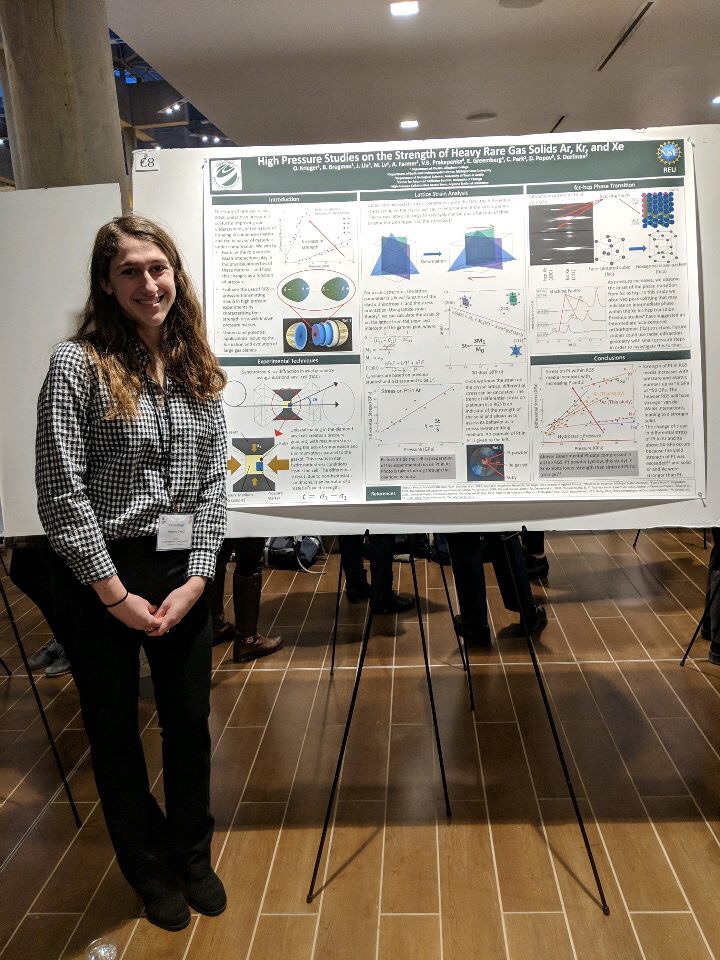
Congratulations to Olivia Krieger on her Best Poster Award at the 2019 American Physical Society Conference for Undergraduate Women in Physics! The poster summarized her summer 2018 REU project (working with Ben Brugman).IMG_1744.jpg

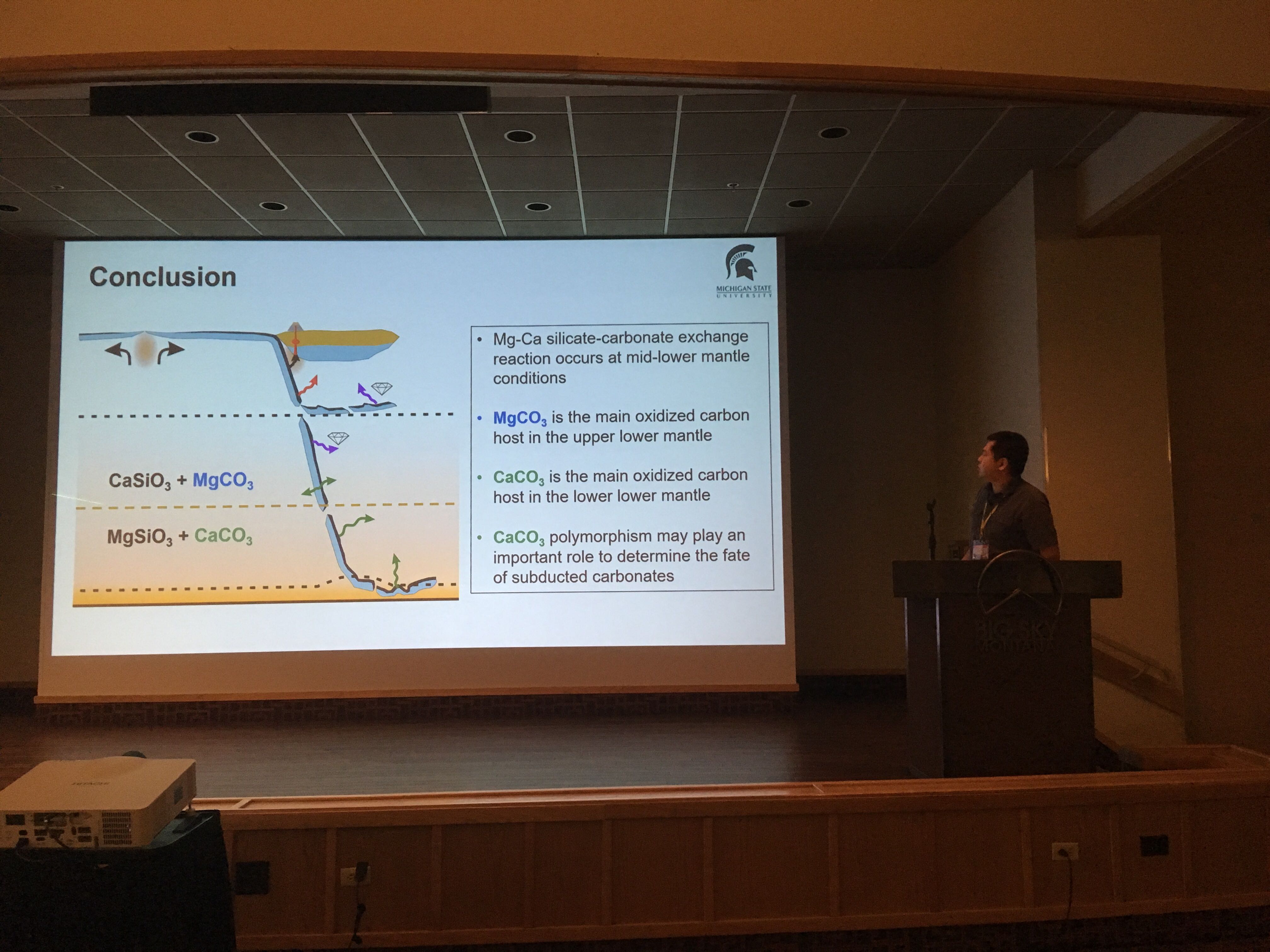
At the 2019 COMPRES Annual Meeting, Ben Brugman received a Best Student Poster Award for his work on “Strength, deformation, and equation of state of tungsten carbide to 66 GPa” (sorry for not getting a photo)! Mingda Lv also delivered an excellent talk on “Experimental constraints on the fate of MgCO3 and CaCO3 subducted into Earth’s lower mantle.”

Mingda_COMPRES_2019.jpg

In spring 2019, we also had 3 new publications accepted!

And one more publication, not peer-reviewed: Suki’s new baby was born in March.

Postdoctoral position in experimental mineral physics/petrology

The experimental mineralogy group in the Department of Earth and Environmental Sciences at Michigan State University (East Lansing, MI) invites applications for a Postdoctoral Research Associate – fixed term. Our research focus is physical properties and chemistry of materials at Mbar pressures/1000s K temperatures of Earth’s mantle. Required qualification is a Ph.D. in Earth and Environmental Sciences or a related field by the start date. Research interests and experience should include at least one of the following: high-pressure mineral physics, experimental petrology, diamond anvil cells, laser heating, synchrotron techniques, and/or electron microscopy. The position is for one year, with possibility of extension based on research performance. Review of applications will begin September 15, 2018 and will continue until position is filled.

The expectations of a Postdoctoral Research Associate include:

  1. Participation and leadership of synchrotron beamtime trips
  2. Carrying out his/her own research
  3. Publishing peer-reviewed papers by collaborating with supervising faculty
  4. Vigorously applying for external grants as PI with supervising faculty as Co-PI
  5. Actively attending workshops, meetings, and conferences
  6. Mentoring both graduate and undergraduate students in the lab

For more information, please contact PI Susannah Dorfman with a letter of interest and CV including list of publications.

MSU is an affirmative action, equal opportunity employer and is committed to achieving excellence through diversity. All qualified applicants will receive consideration without regard to race, color, religion, sex, sexual orientation, gender identity, national origin, disability status, protected veteran status, or any other characteristic protected by law.

Welcome Garrett!

Welcome new Ph.D. student, Garrett Diedrich (B.S. University of Minnesota), starting at MSU Fall 2018! We also say goodbye and great job to our summer REU student, Olivia Krieger, who is heading back to Allegheny College to finish her bachelor’s degree in physics.