Ben Brugman passed his comprehensive exam today and is now a Ph.D. candidate! Congratulations, Ben!
Category Archives: Uncategorized
MSU @ Extreme Physics and Chemistry of Carbon
Suki Dorfman, Mingda Lv, and Experimental Mineralogy group alum Jiachao Liu traveled to ASU this weekend for a workshop with the Extreme Physics and Chemistry community of the Deep Carbon Observatory. Congratulations to Mingda on his first conference talk, “Structure & Properties of Tetrahedral Amorphous Carbon!”
Congratulations to Alison Farmer!
Congratulations to EES senior Alison Farmer on receiving an Undergraduate Research Support Scholarship from the College of Natural Sciences! Alison is also coauthor on an abstract, “Experimental insights into spin state and hyperfine parameters of Fe3+ in bridgmanite and silicate glass up to 91 GPa,” selected for a talk to be presented by Mingda Lv at the 2017 AGU Fall Meeting in New Orleans!
Visit from Dr. Ed Garnero
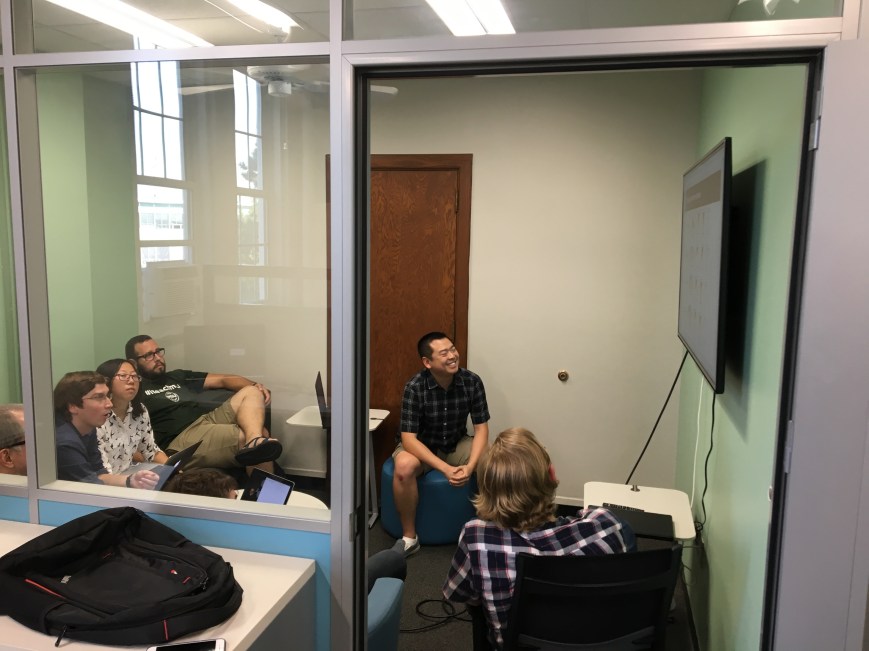
This week, the MSU geophysics groups are hosting Dr. Ed Garnero (ASU) for EES department colloquium! Here are grad students in experimental mineralogy, geodynamics, and U of M seismology groups meeting with Ed in our new geophysics lounge:
MSU @ COMPRES 2017
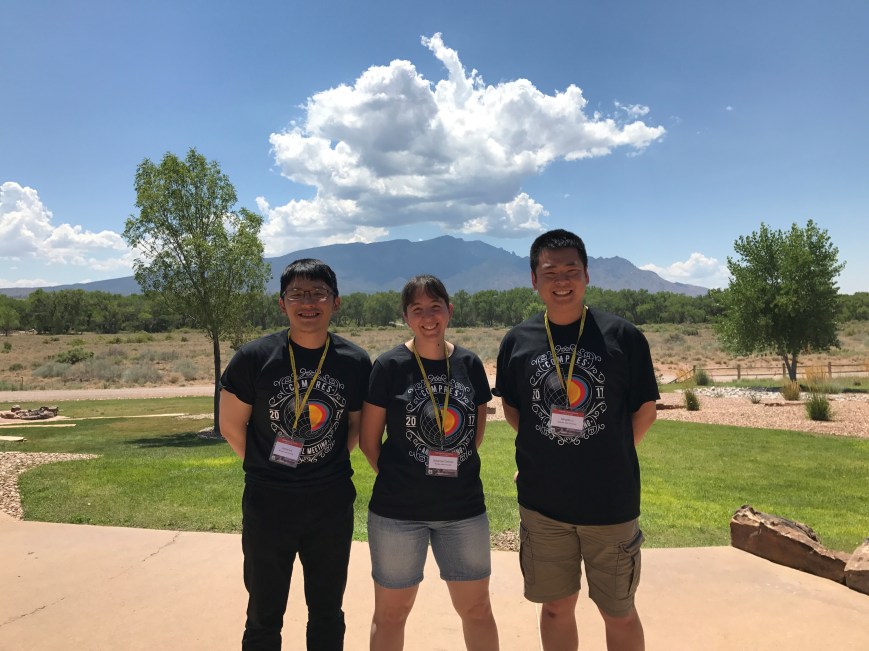
We’re back from the COMPRES 2017 Annual Meeting in Santa Ana Pueblo, NM. Big congratulations to Mingda Lv, who received a student presentation award and was elected to the COMPRES Student and Postdoc Committee! Suki was also elected to Chair the COMPRES Education, Outreach, and Infrastructure Development Committee. MSU had FIVE posters at the meeting:
- J. Liu, S. M. Dorfman, M. Lv*, J. Li and Y. Kono, “Release of Nitrogen during Planetary Accretion Explains Missing Nitrogen in Earth’s Mantle,” COMPRES Annual Meeting 2017.
- M. Lv*, J. Liu, V. B. Prakapenka and S. M. Dorfman, “Thermal equation of state of post-aragonite CaCO3 up to 85 GPa and 2500 K,” COMPRES Annual Meeting 2017. *Received Student Presentation Award*
- E. M. Straley, S. M. Dorfman and J. D. Nicholas, “Demonstration of Thin Film Ruby as a High Spatial Resolution In-Situ Pressure Sensor,” COMPRES Annual Meeting 2017.
- Y. Ma, E. M. Straley, S. M. Dorfman and J. D. Nicholas, “Thin Film Enabled, High Pressure Lab-on-A-Chip Technology for Mineral Physics Applications,” COMPRES Annual Meeting 2017.
- J. Liu, S. M. Dorfman, F. Zhu, J. Li, Y. Wang, D. Zhang, Y. Xiao, W. Bi and E. E. Alp, “Effects of ferric iron on observable properties of the lower mantle,” COMPRES Annual Meeting 2017.
Suki Dorfman is COMPRES Distinguished Lecturer 2017-2018
Text of the announcement from COMPRES:
COMPRES announces the speakers for its 2017-2018 Distinguished Lecture series in the field of Mineral Physics. The talks feature topics that highlight high-pressure geoscience research being conducted within the COMPRES community and its significance for understanding fundamental Earth and planetary processes.
We are pleased to announce that the COMPRES Distinguished Lecturers for 2017-2018 are Suki Dorfman of Michigan State University and Quentin Williams of University of California, Santa Cruz.
The Distinguished Lecture Series was established in 2008 and its objectives include the following
(1) To inform students and faculty at a variety of institutions about the new and exciting work being done within the COMPRES community and at COMPRES facilities, and highlight the connections this work has to other areas of Earth and planetary science and related fields.
(2) To connect COMPRES with members of related scientific research communities (i.e. seismology, geodynamics, geochemistry, material science, planetary, etc.) to help bridge gaps in knowledge and identify areas of mutual interest and/or intersection of ideas.We invite you to request a visit of a COMPRES lecturer to your institution during the coming academic year. COMPRES will fund all travel costs for the speaker, including transportation, accommodation and meals. There is no cost to the hosting institution. The host colleges or universities will be expected to arrange the talks and provide local logistical support. If your institution is interested in requesting a visit, please send your request to Beth Ha [beth3ha@unm.edu] with cc to Carl Agee, President of COMPRES [agee@unm.edu].
Lecture abstracts:
(1) “The Mineral Physics Test Kitchen: Recipes for Earth’s Mantle and Core”
The interiors of Earth and other planets were “cooked” by processes of accretion and
differentiation and can be “tasted” by geochemical sampling at the surface and remote geophysical observations of physical properties at depth. Mineral physics experiments and simulations seek to reverse-engineer the recipes that generate the features we detect in the deep Earth today. Because Earth and other planets are almost entirely composed of materials at high pressures and temperatures, the key to translating geophysical observations to structure and composition is the dependence of mineral stability and physical properties such as density, elasticity, and transport properties on composition and thermodynamic conditions. I will discuss recent observations of chemical reactions and properties of minerals relevant to Earth’s mantle and core, and implications of these experiments for the compositions of layers and regions in the deep Earth.(2) “Redox in Earth’s Interior: Iron and Carbon”
Iron, one of the most abundant elements in our planet, and carbon, the basic element of life, have in common the ability to adopt different electronic states as a result of the range of oxidation conditions that occur on and inside Earth. A wide variety of redox reactions involving iron and/or carbon play important roles in volcanism, deep volatile cycles, planetary dynamics, and our understanding of differences in chemistry in space and time within the Earth. Recent research from the mineral physics community has discovered new iron- and carbon-bearing minerals stabilized by extreme pressures and temperatures of the mantle and core. I’ll dive in to the chemical history and interior structure of the Earth, with a focus on the dynamics of these redox-active materials.
Congratulations and farewells
This week we bid goodbye and good luck to Dr. Jiachao Liu and Mr. Zachary Eriksen. JC has moved to a new position in Prof. Lin’s lab at UT Austin. Zack received his B.S. today as well as the Outstanding Senior and Anna Lee Flory Memorial Scholarship awards from MSU’s Department of Earth and Environmental Sciences. He will start graduate school in Earth and Planetary Sciences at Harvard this fall. Congratulations also to Mr. Mingda Lyu on receiving the Neal Research Scholarship from our department!
Chemistry and Dynamic Implications of Heterogeneous Fe and Si in the Deep Lower Mantle
Champagne time! Image credit: Niels Noordhoek (Wikimedia Commons)
We have just received our first NSF grant for our new project, “Chemistry and Dynamic Implications of Heterogeneous Fe and Si in the Deep Lower Mantle.” This award to PIs Susannah Dorfman (MSU), Allen McNamara (MSU) and Catherine Macris (IUPUI) will be funded by the Collaborative Studies of Earth’s Deep Interior program. Here’s the public abstract:
The composition of Earth’s rocky mantle is fundamentally linked to dynamic processes responsible for the composition and motion of tectonic plates on Earth’s surface. Although the mantle is stirred by convection, it is not well-mixed: images of the mantle obtained from seismology reveal enigmatic regions of unknown composition and age. Progress towards identifying these regions and their role in the history of the Earth has been based on determining the range of compositions and physical properties consistent with remote geophysical observations. Physical properties of mantle minerals can be measured in experiments that mimic the high pressures and temperatures of the deep Earth. Effects of contrast in temperature, density, and viscosity on shapes and dynamics of mantle structures can be tested by simulations of convecting rock. The team combines complementary expertise in experimental mineralogy and computational geodynamics and will train students in both fields, resulting in not only new constraints on the compositions and origins of mantle heterogeneities, but also well-rounded, multidisciplinary young scientists.
Attempts at explaining large low shear velocity provinces (LLSVPs) and ultralow velocity zones (ULVZs) identified by seismology at the base of the mantle involve various combinations of contrasting temperature and composition relative to the surrounding mantle. Possible mechanisms for generating compositional differences have dramatically different implications for the age of these regions, including subduction of modern basalt and segregation of iron-rich mantle during the formation of the planet. Towards understanding these provinces, the project will systematically investigate the effects of variable amounts of iron and silicon on observable properties of the lower mantle phase assemblage such as density and viscosity. A series of well-characterized samples with variable amounts of ferrous iron, ferric iron, and silicon will be compressed to lower mantle conditions to synthesize assemblages of bridgmanite, ferropericlase, and at the highest pressures, post-perovskite. Effects of iron and silicon content on mantle density will be obtained from equations of state. Effects of variable silicate fraction on strength and viscosity of the mantle will be evaluated from observed shear strain. Resulting constraints from experiments on density and viscosity will be incorporated in geodynamic simulations of effects of compositional differences between background mantle and heterogeneous provinces on resulting morphology of thermochemical piles. The results will be shared widely at conferences and on the web and will be of interest to a broad community of solid Earth geochemists and geophysicists.
Suki @ Geophysical Laboratory
Thanks to Dr. Alex Goncharov for the invitation to speak at the Geophysical Laboratory at the Carnegie Institution of Washington!
 Experimental Mineralogy @ MSU